Acoustic communication in birds
Kenya and Australia, 1984-1985
I) In many parts of Africa, local people searching for honey interact with the greater honeyguide (Indicator indicator), a bird that leads them to the nests of wild bees. According to honey gatherers from the Boran tribe (northern Kenya), the birds’ calls, flight patterns and perching height in trees provide information on the direction and distance to the bee nest, as well as its exact location at the destination. Through interviews, field experiments and statistical analyses, we were able to scientifically substantiate these claims.
II) Duets and group songs in birds are generally regarded as ‘peaceful’ signals used to strengthen social bonds. However, our studies of African slate-coloured boubou (Laniarius funebis) and Australian kookaburras (Dacelo novaguineae) suggest that, in these species, synchronised vocalisations signal aggression. They serve to defend territories, monitor mates and maintain hierarchies within a cooperative group.
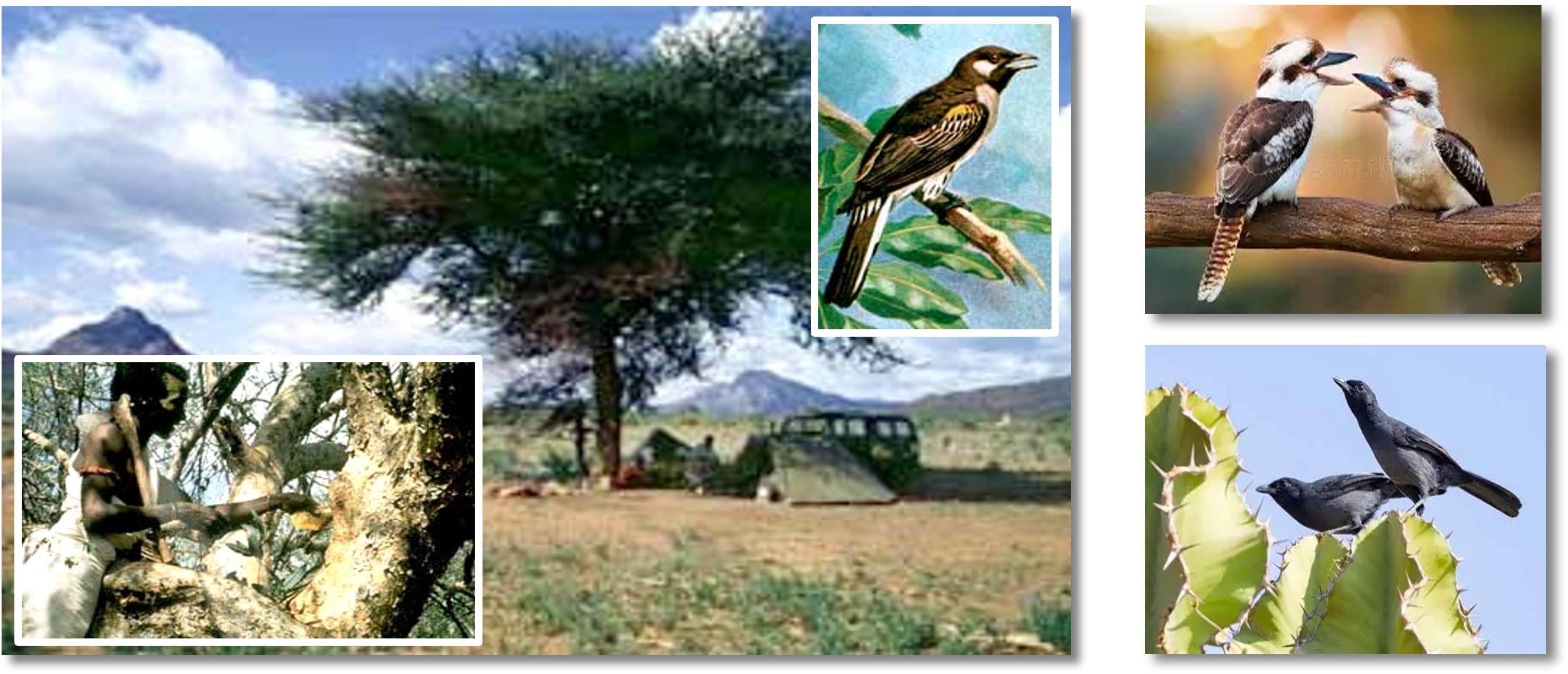
Research camp in northern Kenya, featuring a honey gatherer emptying a bee nest (bottom left) and a greater honeyguide (top right).