Avian mating systems
Schweiz, 1990-1995
Species that live under different ecological conditions are particularly suitable for studying the influence of the environment on mating systems. For this reason, we compared the breeding biology within two bird species: house sparrows (Passer domesticus) in different urban areas and water pipits (Anthus spinoletta) on alpine mountain slopes that differed in terms of microclimate, food availability and predator density.
In house sparrows, breeding success was decisively determined by the microclimate of the nesting site. In water pipits, the social mating system (i.e. who breeds with whom?) ranged from unpaired (0 f/1 m) through polyandrous (1 f/2 m) and monogamous (1 f/1 m) to polygynous (2 f/1 m) birds, with monogamy being the predominant form. The number of females per male reflected the quality of the males, as measured by age, territory size and the quantity of insect food within the territory. The genetic mating system (i.e. who sires offspring with whom?) differed from the social one: Many nests contained young that were sired not by the associated male and/or the associated female. These cases could not be explained by the qualities of the males or females. They resulted from opportunities for extra-pair copulations and intraspecific brood parasitism. These opportunities were facilitated by environmental conditions such as short distances between the nest and shared feeding grounds.
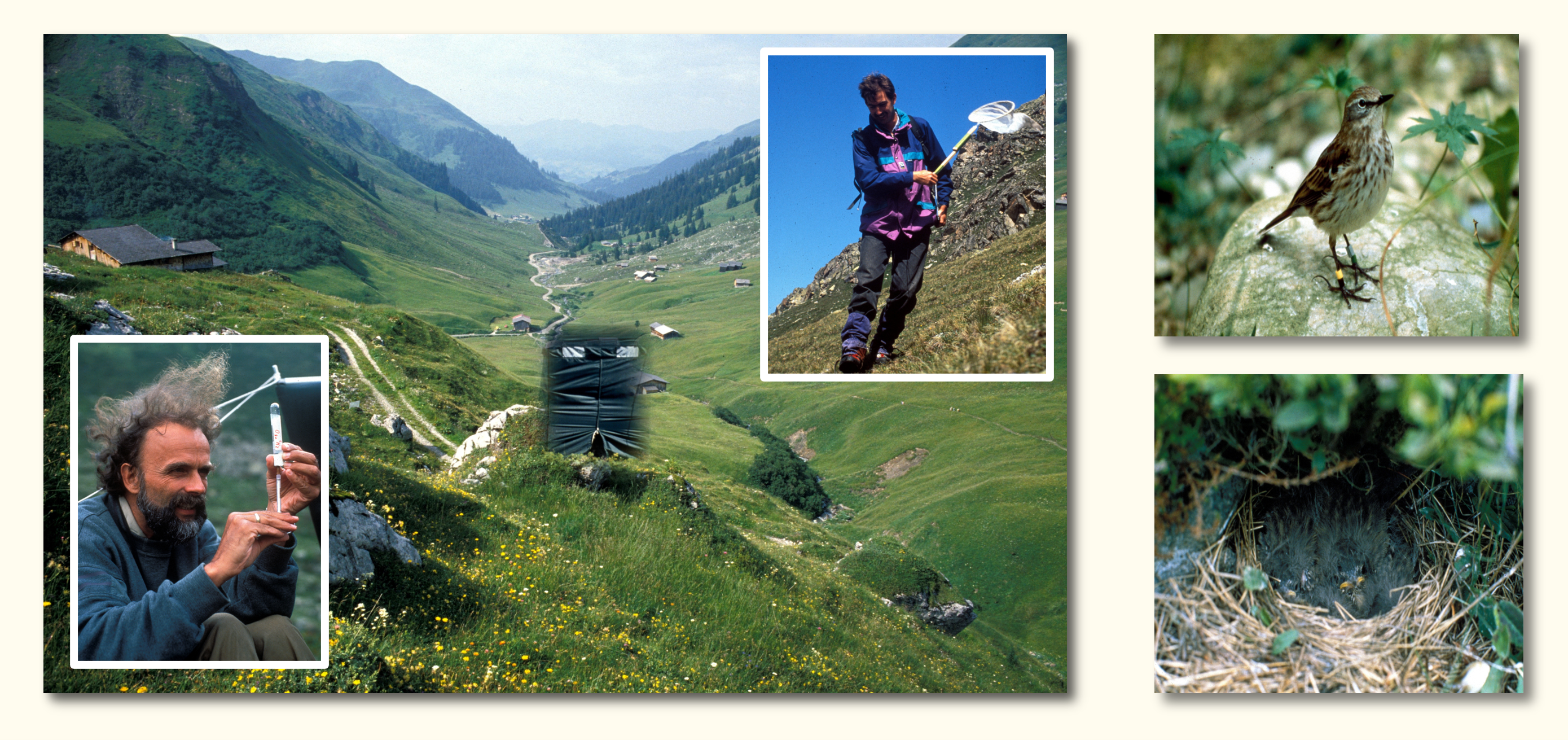
Dischma Valley with an observation tent. The small pictures show energy measurements (bottom left) and insect density surveys (top right).